
-
About Homer
-
- ADA/Title VI Compliance Program City Campgrounds Community Recreation Hickerson Memorial Cemetery
- Library Parks & Trails Public Safety Fire Police Emergency Information
- Events & Activities City Calendar Library Calendar Recreation Calendar Doing Business in Homer Sister City Program Coast Guard City
-
- Departments
- Government
- How Do I?

HERC Analysis of Brownfields Cleanup Alternatives (ABCA)

Through the State's Brownfield Assessment and Cleanup (DBAC) Program, the City engaged the Alaska Department of Environmental Conservation and BGS environmental consultants to assess the HERC property. The consultants reviewed previous Hazardous Building Materials Inventories, conducted a data gap analysis, performed additional sampling of building materials and soils (including testing for lead contamination from deteriorating lead-based paint around both buildings), and developed an Analysis of Brownfield Cleanup Alternatives (ABCA). The ABCA evaluates five cleanup alternatives with rough order magnitude cost estimates to assist informed decision-making on the City’s objectives of demolition and eventual site repurposing.
Executive Summary of the ABCA's Key Findings –
▶ Summary of the primary contaminants of concern and cleanup regulations:
Asbestos (ACM): Multiple building components contain asbestos at concentrations exceeding the 1% regulatory threshold for asbestos-containing material (ACM). Soil samples tested negative for asbestos contamination.
ACM Cleanup Regulations: ACM must be properly encapsulated or abated before general demolition or renovation activities may occur. Because the ACM in the HERC includes surfacing, it presents the greatest potential risk to personnel handling the ACM and abatement must be conducted by certified personnel.
Lead-Based Paint (LBP): Lead paint at or above the EPA regulatory limit of 1.0 mg/cm² was identified on numerous building components in HERC 2 and on the windows, doors, and exterior walls of HERC 1. While lead was detected in all soil samples, concentrations remain well below state residential cleanup levels and do not pose a health risk.
LBP Cleanup Regulations: EPA requires that any renovation or repair work that disturbs lead-based paint be completed by certified contractors following lead-safe work practices.
Polychlorinated Biphenyls (PCBs): No building materials exceed the 50 mg/kg Toxic Substance Control Act (TSCA) threshold.
PCBs Cleanup Regulations: Some materials contain PCB concentrations up to 19 mg/kg. This presents a disposal challenge, as no Alaska landfills are permitted to accept waste containing PCBs at these levels.
▶ Cleanup Alternatives Considered:
Five alternatives were evaluated for effectiveness, implementability and cost. They include:
- No Action: The ACM, LBP and PCBs would not be abated and the buildings would not be demolished.
- Encapsulation of LBP only in both HERC buildings: This alternative would protect the public from LBP exposure.
- Further testing and analysis of building materials: focus on materials that potentially contain LBP and/or PCBs to better define an abatement scope of work that removes only the building materials that are hazardous.
- Abatement and local disposal of ACM and disposal of remaining structures outside of Alaska: Because no local landfills accept disposal of LBP or PCB-containing materials, only the ACMs would be physically removed from the building and disposed of in the Central Peninsula Landfill. The buildings then would be demolished and materials transported to Columbia Ridge Landfill in Oregon for disposal of LBP and PCB-containing waste.
- Abatement via disposal of both buildings outside of Alaska: Removal of the structures and shipped to the Columbia Ridge Landfill in Oregon for disposal of ACM, LBP and PCB-containing waste.
▶ Results:
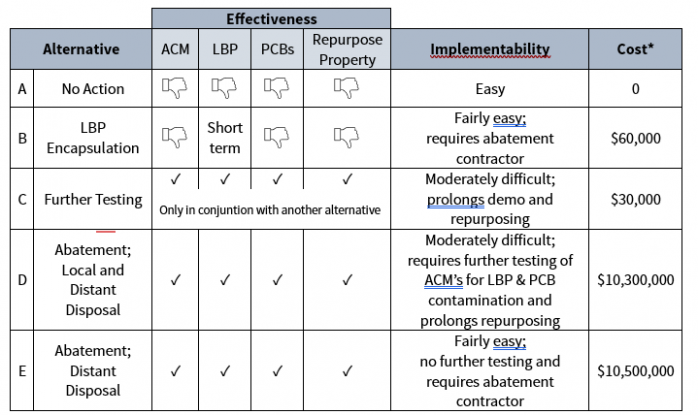
*Cost represents the rough order magnitude cost associated with each remedial alternative. As such, BGES suggested a contingency range from -30% to +50%.
▶ Recommended Cleanup Alternative:
Alternative D was determined the best option for meeting community’s objectives of removing hazardous materials and repurposing the property.
More Information - The complete ABCA report (technical report with detailed data and methodology) is provided at the link below.