-
About Homer
-
- ADA/Title VI Compliance Program City Campgrounds Community Recreation Hickerson Memorial Cemetery
- Library Parks & Trails Public Safety Fire Police Emergency Information
- Events & Activities City Calendar Library Calendar Recreation Calendar Doing Business in Homer Sister City Program Coast Guard City
-
- Departments
- Government
- How Do I?

Homer Spit Coastal Erosion Mitigation
Project Description
This multi-agency project develops, permits, and implements a long-term erosion mitigation and maintenance plan to protect the Homer Spit Road—the State-owned segment of the Sterling Highway that connects Alaska's mainland to critical infrastructure, statewide marine transportation networks through the Homer Port and Harbor, including Alaska Marine Highway facilities and the U.S. Coast Guard.
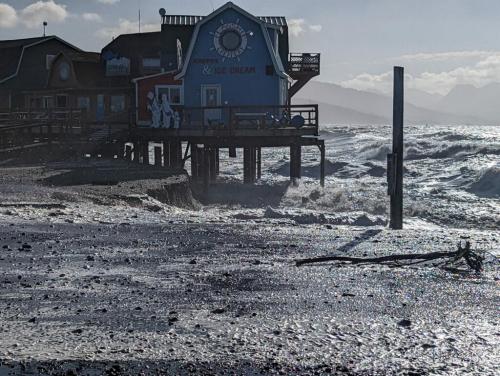
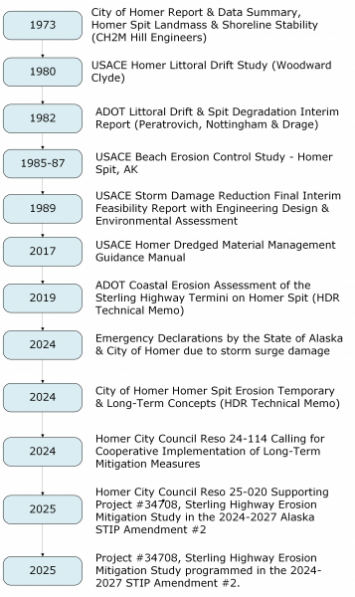
Storm-driven waves are rapidly eroding the road surface, subsurface, and protective rock revetments, causing significant deterioration and loss of right-of-way. Wave action seasonally overtops the roadway, and the predicted threat became reality in November 2024 when a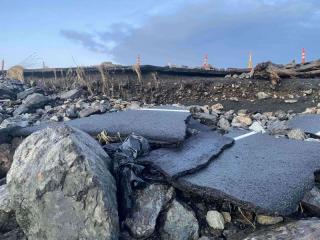 section of road collapsed, triggering local and state disaster emergency declarations and requiring immediate emergency repairs by DOT&PF. (Sterling Highway Erosion Mitigation STIP project #34708)
A cooperative partnership among the Alaska Department of Transportation & Public Facilities (DOT&PF), the US Army Corps of Engineers (USACE), and the City of Homer—leveraging each agency's expertise, mission focus, and jurisdictional authority—will ensure the most effective design, construction and long-term stability of comprehensive erosion protection for this critical transportation corridor.
Scope
- Phase 1: DOT&PF-led erosion mitigation planning, design, and construction to repair and protect Homer Spit Road, milepost 134-138, which was damaged by the 2024 storm. Improvements may include excavation, coastal erosion protection, paving, signing and striping, and utility relocation.
- Phase 2: Develop and construct more comprehensive, long-term erosion mitigation measures, maintenance plans and agreements, and obtain USACE authorization to implement maintenance-level beach nourishment as outlined in the Homer Spit Dredged Material Management Plan.
- Federal authorization of a project under Section 8315 of the Water Resources Development Act (WRDA) of 2022 provides an appropriate framework for moving Phase 2 forward. It authorizes the USACE to carry out structural and nonstructural flood risk management projects in partnership with local sponsors targeting storm damage prevention, coastal erosion, and glacial damage in Alaska through a more expedited process. Alternatively, Section 203 of the Water & Resources Development Act provides a pathway for non-Federal entities to drive the initial feasibility and design phase of a project, particularly to enable faster progress on projects.
Phase 1

Cost Estimate
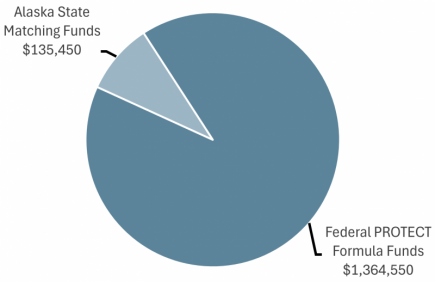
Phase 1 funding is shown in the chart below. DOT&PF has an additional Planned Obligation of $6.1M programmed for post FY27 in the STIP for the execution phase. Cost estimate for Phase 2 is unknown at this time.
Need and Benefits
The Homer Spit Road serves as a lifeline—not just for Homer, but for communities across Southcentral and Western Alaska. This 4.5-mile corridor carries critical infrastructure of local, statewide, and national significance, functioning as the primary transportation hub and commerce center for the region. Loss of road connection—a serious concern since the early 1990s—remains ever-present.
Regional Transportation Hub: The Homer Spit Road is the terminus of Alaska Highway Route 1 and the sole overland freight route to and from Homer's Port and Harbor. With 4,290 vehicles traveling this double-lane Principal Arterial daily, it connects Alaska's road system to maritime routes serving remote communities throughout the region.
Critical Federal and State Infrastructure: The Spit hosts essential facilities including: U.S. Coast Guard operations, Alaska Marine Highway System (AMHS) ferry terminal, inter-agency emergency telecommunications infrastructure, bulk fuel storage, and Federal agency operations vital to statewide services.
Economic Engine: The Spit and the Homer Port and Harbor facility support commercial fishing, recreational tourism, and industrial operations that drive the regional economy. Hundreds of land-based and marine businesses, in Homer and through statewide supply chains, depend on reliable multimodal access to the Homer Spit as their gateway to commerce.
Cascading Costs: Piecemeal, isolated responses drive escalating expenditures without addressing root causes.
Federal Investment: USACE addressed erosion with 1,000 feet of rock revetment in 1992, extended an additional 3,700 feet in 1998. This infrastructure inadvertently caused downdrift erosion on less-protected beaches south of the revetment, creating new vulnerable areas requiring additional intervention.
State Investment: The State has similarly invested heavily in protective measures and emergency repairs to keep the road operational. In 1982, DOT&PF executed an emergency repair using unreinforced concrete block revetment after a storm damaged protective sheet pile wall and riprap armor and destroyed a portion of the road. DOT&PF later armored the highway in two additional emergency revetment projects to address downdrift erosion caused by the federal revetment. By 2007, the State had spent more than $6 million on repairs and protection measures over a 20-year period. These armored areas require ongoing maintenance due to periodic overtopping that damages roadway shoulders. The November 2024 storm surge washed away substantial portions of road right-of-way and collapsed one lane of Alaska Highway 1—prompting over $3M in temporary repairs and protection measures.
Private Property Owners: According to the U.S. Army Corps of Engineers (USACE), shoreline structures have suffered varying degrees of damage, forcing property owners to invest $20,000 to $50,000 per repair incident—with some requiring annual maintenance. These ad-hoc erosion control efforts (rip-rap, gabions, sandbags, makeshift rock barriers) provide only temporary relief while the underlying threat intensifies.
Natural Resource: Beyond its economic importance, the Homer Spit is a unique coastal feature and valuable environmental asset, providing extensive bird and marine habitat that contributes essential benefits to the region's ecosystem.